

Medically Verified by – Dr Jitendra Singh M.B.B.S, M.D (Pediatrician & Neonatologist)
Eating is an important part of a child’s growth, but it also comes with risks that many parents underestimate. Food choking hazards in children is among the top causes of accidental injuries among babies and toddlers below the age of five. Even ordinary food may pose a threat since small children are yet to master the skills of chewing and swallowing.
Knowledge of the dangers of choking, its prevention and response in the case of an emergency can guide parents to keep their children safe and take quick action in case of a situation like this.
What is Choking?
A lot of parents are confused about what choking is and how it varies with the usual difficulties in feeding. Choking happens when the airway is covered up by an object or food and it prevents the intake of air. Otherwise, this blockage may lead to severe complications unless it is addressed immediately.
Airway obstruction in children can happen suddenly like while eating meals or during playtime or when small objects are placed in the mouth by babies. It is very important to know when it is discomfort or danger so that you can act promptly.
Choking vs Gagging: Understanding the Difference
Parents get confuse between choking vs gagging, as both of these situations are very much different. Gagging is a normal reflex as it helps in prevent choking. A child may push food forward, make noises or cough when gagging. In contrast, choking is silent and more dangerous. Signs of choking in children are:
- Inability to cry or speak
- Silent coughing or no sound
- Difficulty breathing
- Bluish lips or face
- Panic or clutching throat
All of these choking symptoms must be identified so in order to avoid life-threatening complications.
Common Causes of Choking in Children
There are numerous causes of choking as children at this age have smaller airways and are not able to chew properly. They also prefer to put things in their mouths which increase the chances of choking. Common causes are as follows:
- Eating very fast
- Talking or laughing at the time of eating
- Not chewing properly
- Running or playing while eating
- Giving unsafe food textures
- Lack of supervision during meals
To minimize these accidents it is advisable that parents should and must monitor their children when eating. To guide families, the best paediatrician in Lucknow at the Sanjivini Hospital might assist the parents to learn the safe feeding and prevention measures.
Dangerous Foods for Kids Under 5
There are certain foods that are considered as major choking hazards for children particularly for toddlers and infants. According to the CDC’s choking prevention guidelines, foods that are small, round, hard, sticky, or difficult to chew pose a higher choking risk for young children. Below mentioned are those foods that may cause choking hazards for toddlers:
- Whole grapes or cherry tomatoes
- Nuts and seeds
- Popcorn
- Hard candies or chewing gum
- Raw carrots or apples
- Sausages or hot dogs
- Large chunks of meat or cheese
- Peanut butter in thick amounts
These foods that cause choking in toddlers may obstruct the air passage of a toddler.
Choking Hazards for Babies and Infants
Babies need some extra care because their chewing skills are still in the development phase. Choking hazards for babies often include foods that are either too firm or are foods not mashed properly. Important aspects of baby feeding safety include:
- Soft, mashed, or pureed textures
- Avoiding hard foods before readiness
- Gradual introduction of solids
- have a proper sitting posture while feeding
Parents must know how to prevent choking in babies as it will help reduce emergency situations. And even parents introducing solids should also focus on correct food textures and safe preparation methods. Read our guide on safe baby-led weaning and choking prevention techniques to learn how to introduce finger foods safely while minimizing choking risks.
Age-Appropriate Food Sizes and Safe Preparation
Preparation of food plays a critical role towards ensuring that kids are not choking. The parents must give their child only age-appropriate food sizes and with safe textures. These are some tips for how to cut food safely for toddlers:
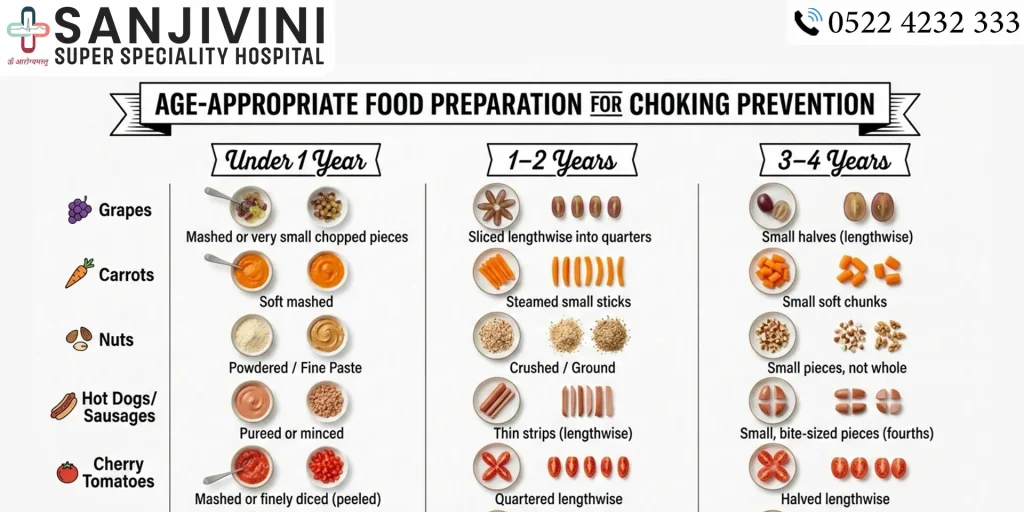
- Slice grapes into like quarters lengthwise
- Shred or finely chop meat
- Cooking vegetables till they are soft
- Avoiding round or coin-shaped slices
- Always give small bite-sized portions
These concepts do not only make toddlers eat safely but also assist them to be more independent.
Choking Prevention for Children
It is easier to prevent choking than to manage an emergency of choking. By establishing healthy habits parents can definitely prevent child choking. Here are some choking safety tips for kids:
- See that children sit upright when eating meals
- Avoid distractions like watching mobile or TV
- Teach slow chewing
- Watch snack time closely
- Keep all the small objects away from the infants
What to Do if a Child is Choking
Parents should know what to do in case the child chokes as immediate response is critical when a child has choked on food. Basic child choking emergency steps are these:
- Check the child’s breathing
- Tell them to cough as much as possible
- Give age-appropriate back blows or abdominal thrusts
- Call emergency services if he/she is not able to breathe
- Do consult doctor after the incident
Parents are advised to train child choking first aid and pediatric first aid to enable them deal with such an emergency at home.
First Aid for Choking Child at Home
If a child is choking on food, first parents should act quickly before even reaching any nearby hospital for help. Important actions to take:
- For infants: Give them a back blows and chest thrusts
- For older children: Give them a abdominal thrusts (Heimlich maneuver)
- Do not blindly sweep inside the mouth
- Monitor breathing continuously
Even after recovery, evaluation may be needed to rule out complications.
When to Go to Hospital for Choking Child

Facilities like Sanjivini Super Speciality Hospital in Lucknow can give your child the best possible and advanced Pediatrics and Neonatology services in a comprehensive emergency environment to manage such situations safely. Parents should seek pediatric emergency care immediately if:
- The child turns blue or unconscious
- Breathing remains difficult
- Food does not come out
- Coughing continues
- Child looks weak or lethargic
The critical care may be required in case of severe choking, in particular, in case the child will have the oxygen level decreased.
Role of Medical Experts in Preventing Choking Risks
Doctors teach parents to cook in a safe and non-hazardous way. They are able to determine whether a child is prepared to take new foods and the manner of transitioning through the foods.
Full care hospitals including those that provide support to newborns are useful in preventing and treating choking emergencies.
Frequently Asked Questions
What to do if a child is choking?
In case a child is not able to breathe, cry or even speak, provide first aid immediately. And back blows or chest thrusts and that too based on the age of the child and call emergency help too.
When to go to hospital for choking child?
Take the child to the hospital in case of any difficulty in breathing or if the child becomes unconscious. A proper check-up is provided by visiting a women and children hospital near me.
How to prevent choking in babies?
Avoid choking by feeding them soft foods and cutting the food into smaller pieces and observe your child while he or she is eating, and make sure the baby sits straight when eating.
Should I consult a doctor after a choking episode?
Yes, especially for infants. A pediatrician or neonatologist near me can check for airway irritation or complications after choking.
Final Thoughts on Food Choking Hazards in Children
Awareness is the first step toward prevention. Parents reduce the threat by a significant margin when they know what foods may be risky for their baby. And even practice safe feeding and parents must take their child to best paediatric hospital in Lucknow like Sanjivini Super Speciality Hospital in an emergency.
Through cautious measures, observance and prompt medical assistance, the majority of the food choking hazards in children can be prevented, and children can enjoy their trying out foods without fear.
Pingback: lasix generic
Pingback: where can i buy ivermectin
Pingback: finasteride for bph
Pingback: metoprolol 50 mg tablet